
Building a learning platform sounds exciting.
But most businesses ask a simple first question: how much will LMS development cost in India? The answer depends on multiple factors, from features and design to technology and team structure. This guide explains everything in a clear and practical way, so leaders can plan better and avoid surprises.
The growing demand for digital learning makes this question even more relevant. The global eLearning market will pass $400 billion in the next few years.
This shows how fast businesses adopt online training. About 90% of organizations now offer digital learning. Companies with structured eLearning report up to 42% higher employee productivity. These numbers show a clear shift to scalable, tech-driven learning.
With this rapid growth, investing in an LMS is no longer just an option. A smart move for businesses that want to stay competitive, cut training costs, and provide consistent learning for teams is to do so now.
Why Businesses Are Investing in LMS Platforms?
Learning platforms are no longer limited to schools or universities. Companies now use them for training, onboarding, certifications, and customer education.
A well-built LMS can:
- Reduce training costs over time
- Improve employee productivity
- Provide measurable learning outcomes
- Support remote and hybrid teams
With digital learning growing fast, businesses are shifting from traditional training methods to scalable LMS solutions.
How a Learning Management System (LMS) Works?
A Learning Management System (LMS) is software that helps create, manage, and deliver learning or training content. It lets users access courses, track progress, and measure performance.
Core Functions of an LMS
- Course creation and management
- User enrollment and tracking
- Reporting and analytics
- Certification management
- Integration with other tools
Key Factors That Influence LMS Development Cost
The total learning management system development cost in India is not fixed. It varies based on how complex and feature-rich the platform needs to be.
1. Type of LMS
Different LMS types come with different cost structures.
| LMS Type | Description | Cost Impact |
| Cloud-based | Hosted online, subscription model | Lower upfront cost |
| Self-hosted | Installed on your own server | Higher setup cost |
| Custom LMS | Built from scratch | Highest cost but fully flexible |
2. Features and Functionalities
The more advanced the features, the higher the development cost.
Basic Features
- User login and profiles
- Course management
- Simple dashboards
Advanced Features
- AI-based recommendations
- Engagement (badges, leaderboards)
- Video conferencing integration
- Mobile apps
- Multi-language support
3. UI/UX Design
A simple design costs less. A highly interactive, visually rich interface costs more. Good design improves user engagement, so it is worth investing in.
4. Technology Stack
The choice of programming languages, frameworks, and infrastructure affects both cost and performance.
Common technologies include:
- Frontend: React, Angular
- Backend: Node.js, PHP, Python
- Database: MySQL, MongoDB
5. Development Team Location
Hiring developers from different regions can change pricing a lot.\
| Region | Hourly Rate |
| India | $20 – $50 |
| Eastern Europe | $40 – $100 |
| USA/UK | $100 – $200 |
This is why many businesses prefer outsourcing to experienced teams in India.
6. Third-Party Integrations
Integrations with tools like CRM, payment gateways, or video platforms add to the cost.
Examples:
- Zoom or video APIs
- Payment gateways
- HR software
- Analytics tools
LMS Development Cost Breakdown
Here is a rough estimate based on complexity:
| Complexity Level | Estimated Cost |
| Basic LMS | $10,000 – $25,000 |
| Medium LMS | $25,000 – $60,000 |
| Advanced LMS | $60,000 – $150,000+ |
Development Stages and Their Costs
Understanding how an LMS is built step by step makes budgeting much easier. Each stage has its own purpose, timeline, and cost impact. Skipping or rushing any phase can lead to higher expenses later, so a structured approach always pays off.
1. Planning and Research
This is the base of the whole project. At this stage, we focus on business goals, target users, and technical needs.
What happens here:
- Defining the project scope and goals.
- Identifying the target audience, such as students, employees, and partners.
- Researching competitors and the market.
- Listing features and organizing them.
- Creating a product roadmap.
Why it matters:
Clear planning cuts rework and avoids extra features that raise costs later.
Estimated Cost: 5–10% of the total budget
2. UI/UX Design
Once the plan is ready, the next step is to design the platform’s look and feel. A clean, easy-to-use interface boosts user engagement and retention.
What happens here:
- Wireframing (basic layout structure)
- Creating user journeys
- Designing dashboards and course pages
- Building interactive prototypes
Why it matters:
Good design reduces confusion and improves usability, which directly impacts learning outcomes.
Estimated Cost: 10–15% of the total budget
3. Frontend Development
This stage focuses on what users see and use on the platform.
What happens here:
- Building responsive web interfaces.
- Creating student and admin dashboards.
- Adding navigation and course views.
- Keeping a consistent mobile experience.
Why it matters:
A smooth frontend experience keeps users engaged and helps reduce drop-offs.
Estimated Cost: 15–25% of the total budget
4. Backend Development
The backend functions as the core engine powering the LMS. It handles data, logic, and system operations.
What happens here:
- User validation and role management.
- Course management system
- Database setup and management
- API development for integrations
- Performance optimization.
Why it matters:
A strong backend ensures growth, security, and reliability.
Estimated Cost: 25–35% of the total budget
5. Feature Integration
At this stage, we add advanced features to improve the learning experience.
What happens here:
- Video streaming integration
- Payment gateway setup
- Engagement features (badges, leaderboards)
- Analytics and reporting tools
- Third-party integrations (CRM, HR tools)
Why it matters:
These features improve engagement and make the platform more powerful.
Estimated Cost: 10–20% of the total budget
6. Testing and Quality Assurance
Before launch, the platform must be tested thoroughly to ensure everything works as expected.
What happens here:
- Functional testing
- Bug fixing
- Performance testing
- Security checks
- Cross-device and cross-browser testing
Why it matters:
Fixing issues early is much cheaper than handling failures after launch.
Estimated Cost: 10–15% of the total budget
7. Deployment
This is when the LMS goes live and users can access it.
What happens here:
- Server setup and configuration
- Domain and hosting setup
- Final performance checks
- Launch support
Why it matters:
A smooth deployment reduces downtime and helps create a better first impression.
Estimated Cost: 5–10% of the total budget
8. Maintenance and Updates
The work does not end after launch. You need ongoing updates to keep the LMS running well.
What happens here:
- Bug fixes and performance improvements
- Feature updates
- Security patches
- Server monitoring
- User support
Why it matters:
Regular maintenance keeps the platform secure, fast, and up to date.
Estimated Cost: 15–20% of the total budget annually
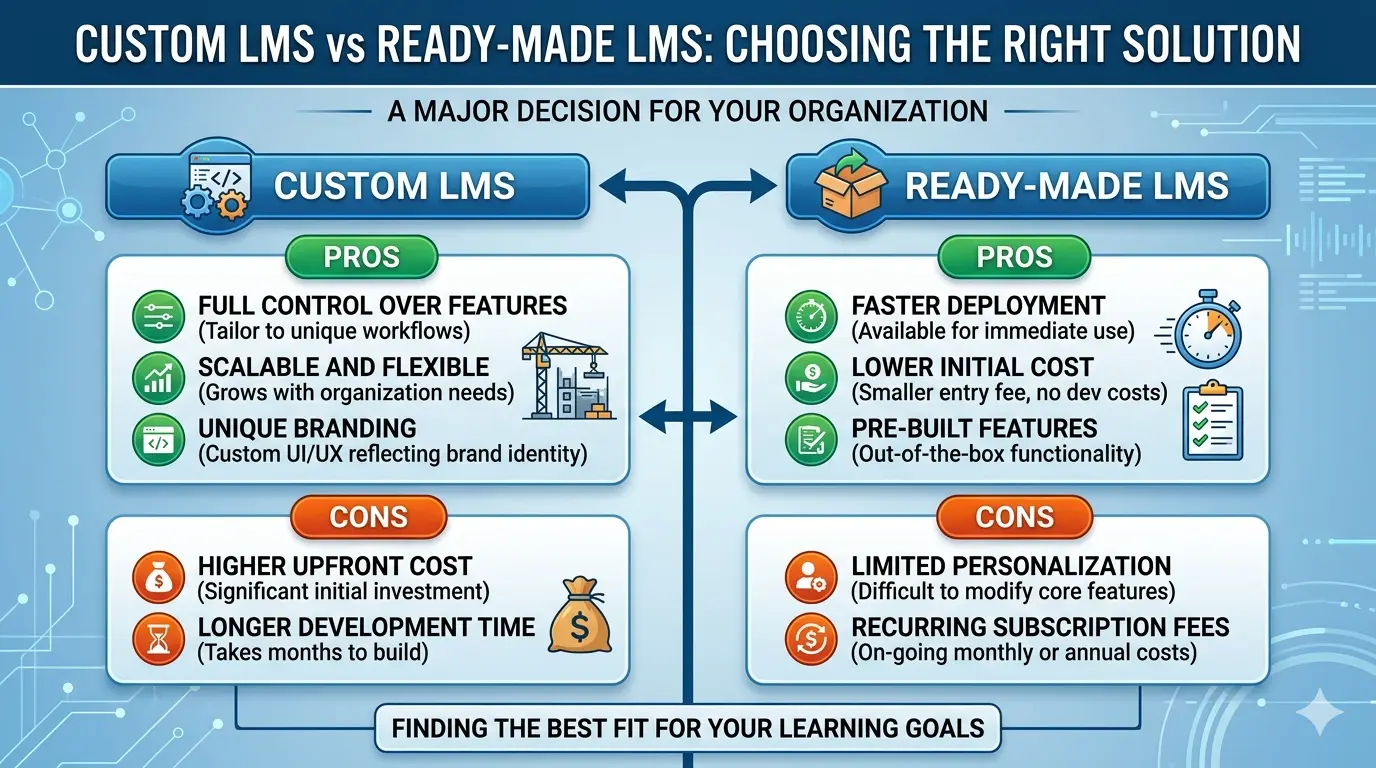
Custom LMS vs Ready-Made LMS
Choosing between custom and ready-made solutions is a major decision.
Custom LMS
Pros
- Full control over features
- Scalable and flexible
- Unique branding
Cons
- Higher upfront cost
- Longer development time
Ready-Made LMS
Pros
- Faster deployment
- Lower initial cost
- Pre-built features
Cons
- Limited personalization
- Recurring subscription fees
Cost-Saving Tips for LMS Development
Creating an LMS does not always require a huge investment. Smart planning can greatly reduce costs.
- Start with an MVP (Minimum Viable Product)
- Prioritize must-have features first
- Use open-source technologies
- Avoid unnecessary integrations early
- Choose an experienced development partner
Hidden Costs You Should Know
When planning an LMS, most businesses focus only on development costs. But several other expenses can affect the total budget over time. Ignoring these hidden costs can lead to higher spending later.
Understanding them early helps in better planning and avoids unexpected financial pressure.
1. Hosting and Server Costs
An LMS needs reliable hosting to run smoothly, especially if it handles a large number of users.
What affects the cost:
- Number of active users.
- Video and File Storage Needs.
- Managing Traffic and Bandwidth Efficiency
Why it matters:
As your platform grows, hosting costs rise. Poor hosting can also hurt performance and user experience.
2. Third-Party Integrations
Integrating external tools adds features but also raises costs.
Examples:
- Payment gateways
- Video conferencing tools
- CRM and HR systems
- Analytics platforms
Why it matters:
Some integrations have monthly fees or fees based on use.
3. Licensing Fees
Some tools, plugins, or technologies used in development may need licenses.
Examples:
- Premium plugins
- Third-party APIs
- Software licenses
Why it matters:
These are recurring costs that can add over time.
4. Training and Support Costs
Even after development, users may still need guidance to use the platform well.
Includes:
- Admin training
- User onboarding sessions
- Customer support
Why it matters:
Proper training helps people adopt new methods and reduces confusion.
How Long Does LMS Development Typically Take?
Development time depends on the complexity of the platform.
| LMS Type | Timeline |
| Basic | 2–3 months |
| Medium | 4–6 months |
| Advanced | 6–12 months |
Industry Use Cases of LMS
Learning Management Systems are no longer only for education. Today, many industries use them to improve training. They also help share knowledge and boost performance.
Each sector uses LMS platforms in a slightly different way. This depends on its goals and challenges.
1. Corporate Training
Companies use LMS platforms to train employees well and consistently. They help standardize learning across teams, especially in large or remote organizations.
Common use cases:
- Employee onboarding programs
- Compliance and policy training
- Leadership and skill development
- Sales and product training
Benefits:
- Reduces training costs
- Ensures consistent learning
- Tracks employee performance
2. Education Sector
Schools, colleges, and universities use LMS platforms for online and hybrid learning. LMS platforms help educators manage courses and track student progress in one place..
Common use cases:
- Online classes and assignments
- Track student performance
- Manage exams and certifications
- Support collaboration between students and teachers
Benefits:
- Flexible learning environment
- Easy access to study materials
- Better student engagement
3. Healthcare Industry
Healthcare organizations use LMS platforms to train staff. They also help staff stay updated on new practices and rules.
Common use cases:
- Medical certification programs
- Compliance training
- Clinical skill development
- Patient care training
Benefits:
- Improves staff knowledge
- Ensures regulatory compliance
- Enhances patient safety
4. E-commerce and Retail
In the e-commerce space, LMS platforms are used to educate both employees and customers. Training staff on products and processes improves overall service quality.
Common use cases:
- Product knowledge training
- Customer onboarding tutorials
- Vendor and partner training
- Sales team training
Benefits:
- Better customer experience
- Improved sales performance
- Faster onboarding
5. IT and Software Companies
Tech companies use LMS platforms to keep teams updated with new tools, technologies, and processes.
Common use cases:
- Technical skill training
- Certification programs
- Developer onboarding
- Internal knowledge sharing
Benefits:
- Keeps teams up to date
- Encourages continuous learning
- Improves productivity
Why Choose Mayankal Technologies for LMS Development ?
Selecting the right development partner is as important as planning the platform.
Mayankal Technologies builds scalable, user-friendly LMS platforms that fit your business needs.
What Sets Them Apart
- Experienced development team
- Custom LMS solutions
- Affordable pricing plans
- Strong focus on UI and UX
- Ongoing support and upkeep
Future Trends in LMS Development
The LMS industry is changing fast as new technologies reshape learning and content use.
Approaches that once delivered results no longer work.
People now expect modern platforms to be smarter, faster, and more engaging.
Adapting to these changes is not just about staying current. It affects user experience, learning results, and the platform’s long-term success.
Key Trends
1. AI-Powered Learning Paths
Artificial intelligence is making LMS platforms more personal.
Instead of showing the same content to everyone, AI studies user behavior, progress, and performance.
It then suggests courses that fit each user.
This helps:
- Improve learner engagement
- Reduce course drop-offs
- Deliver tailored learning experiences
2. Microlearning Modules
Short, focused lessons are more popular than long training sessions.
Users prefer content they can finish quickly, especially at work.
Benefits include:
- Better knowledge retention
- Faster course completion
- More flexibility for learners
3. Mobile-First Platforms
Most users now view content on mobile devices. LMS platforms are moving to mobile-first design for a smooth experience on phones and tablets.
Key advantages:
- Learning anytime, anywhere
- Higher user participation
- Improved availability
4. Virtual and Augmented Reality Learning
Immersive tools like VR and AR are changing how we teach complex topics. They let users try real-world scenarios in a safe, controlled digital space.
Common use cases:
- Medical training
- Industrial simulations
- Safety training programs
5. Advanced Analytics
Data-based insights are becoming vital for businesses. Modern LMS platforms provide clear analytics to track learner progress and performance.
This helps organizations:
- Measure training effectiveness
- Identify skill gaps
- Make better decisions
Final Thoughts
Understanding the learning management system development cost helps businesses make better decisions and avoid overspending. The right approach is to focus on value, not just price.
A well-planned LMS can bring long-term benefits, improve learning results, and build a strong competitive edge. Working with a trusted company like Mayankal Technologies helps you build the platform faster. It helps you stay on budget and meet business goals.
Hi, I’m Akhil Kumar Srivastava, Founder & CEO of Mayankal. We’re a team of highly skilled developers helping startups and established companies transform powerful ideas into successful digital products. We build high-quality websites, mobile apps, AI-driven tools, and full-scale SaaS solutions.
Our Blog
Explore Our Latest Multi-Location
Marketing Insights
17 Apr 2026
Cost to Develop an Astrology App Like Astrotalk in 2026

Akhil Kumar Srivastava

04 Apr 2026
Top 10 No-Code Tools for Mobile App Development in 2026
Akhil Kumar Srivastava
23 Jan 2026
Detailed Guide on AI Agent Development Cost in 2026
Akhil Kumar Srivastava

09 Jan 2026
Gojek Business Model Complete Guide
Akhil Kumar Srivastava
02 Feb 2026
Trending Mobile App Development Frameworks in 2026
Akhil Kumar Srivastava