
.webp)
Real estate business is no longer constrained to the physical space and structures. There is a new online frontier that is transforming the manner in which individuals purchase, sell, and invest in property. The emergence of virtual real estate metaverse platforms has provided developers, investors, and businesses with the chance to create and commercialise digital spaces within immersive virtual worlds.
The notion of branded virtual offices, NFT-based parcels of land, is rapidly changing. Companies that are able to respond early are able to be ahead of the curve. It is here that the high-tech metaverse real estate development and smart apps solutions are needed.
We shall discuss the way this change is occurring and how companies can create apps that are powerful in the future.
Understanding Virtual Real Estate in the Metaverse
In the immersive 3D worlds, digital land or property is known as virtual real estate. These properties may be purchased, sold, rented, or even developed like physical real estate. They are accessed by users using virtual reality headsets or web-based 3D.
The virtual real estate metaverse is not in gaming. It has virtual malls, art galleries, company offices, venues, and social centers. The brands are investing in such spaces to reach out to audiences differently.
Blockchain-based assets have been a popular way to guarantee digital ownership, as they offer authenticity and transparency. Due to its rising use, there is a rising demand for strong metaverse real-estate development.
Why Metaverse Real Estate Is Gaining Popularity
The metaverse facilitates immersions and interactions, which single websites are unable to provide. Investors consider it an avenue of owning early digital assets that can appreciate with time.
Some key drivers include:
- Increasing use of VR and AR technologies.
- Expanding demand regarding NFTs and digital assets.
- Development of online shows and trade.
- Remote working space demand.
The metaverse and virtual real estate markets are also being investigated by businesses to make digital ecosystems that replicate property models in real life.
How Apps Power the Metaverse Property Economy ?
Not behind every successful virtual property platform is a powerful mobile or web application. An efficient real estate app can enable people to visit digital homes, explore 3D spaces, conduct safe transactions, and take care of property.
The Modern real estate application platforms combine functions such as:
- 3D property visualization
- Digital wallet integration
- NFT ownership management
- Virtual tours
- Marketplace listings
- Secure payment gateways
The proper transactions and user engagement are hard to handle without an effective real estate app development strategy.
Key Features of a Metaverse Real Estate App
Competing in this space requires businesses to not simply be able to list businesses. Innovative apps revolve around the aspects of immersion and interactivity.
Property Viewing in 3D
The users ought to be in a position to navigate a three-dimensional, realistic digital land and buildings
NFT-Based Ownership
The introduction of blockchain will provide secure digital ownership records.
Smart Contracts
Smart contracts simplify business operations and decrease fraud.
AI-Powered Recommendations
Through AI in real estate, platforms have the ability to provide users with suggestions on the property to buy according to their actions and preferences.
Secure Digital Payments
Financial transactions are secured by integrated wallets and multi-layered security.
The scalable plan of real estate apps will make these features work even with the increase in users.
The Role of AI in Virtual Real Estate
The physical and digital markets of property are undergoing changes with the implementation of Artificial Intelligence. AI in real estate helps to understand the behavior of users, predict the expected investment, and offer personalized recommendations for the property.
In metaverse platforms, AI can:
- Propose lucrative strategic spots of land virtually.
- Automate the valuation of property.
- Identify abnormal transactions.
- Improve search algorithms
- Enhance user engagement
AI enhances efficiency and smarter decision-making when it is incorporated into a real estate app.
Metaverse Real Estate Development Process
Contemplating creating an effective platform requires a systematic endeavor. A professional real estate development company that is knowledgeable in immersive technologies and blockchain integration should be considered as a partner to the businesses.
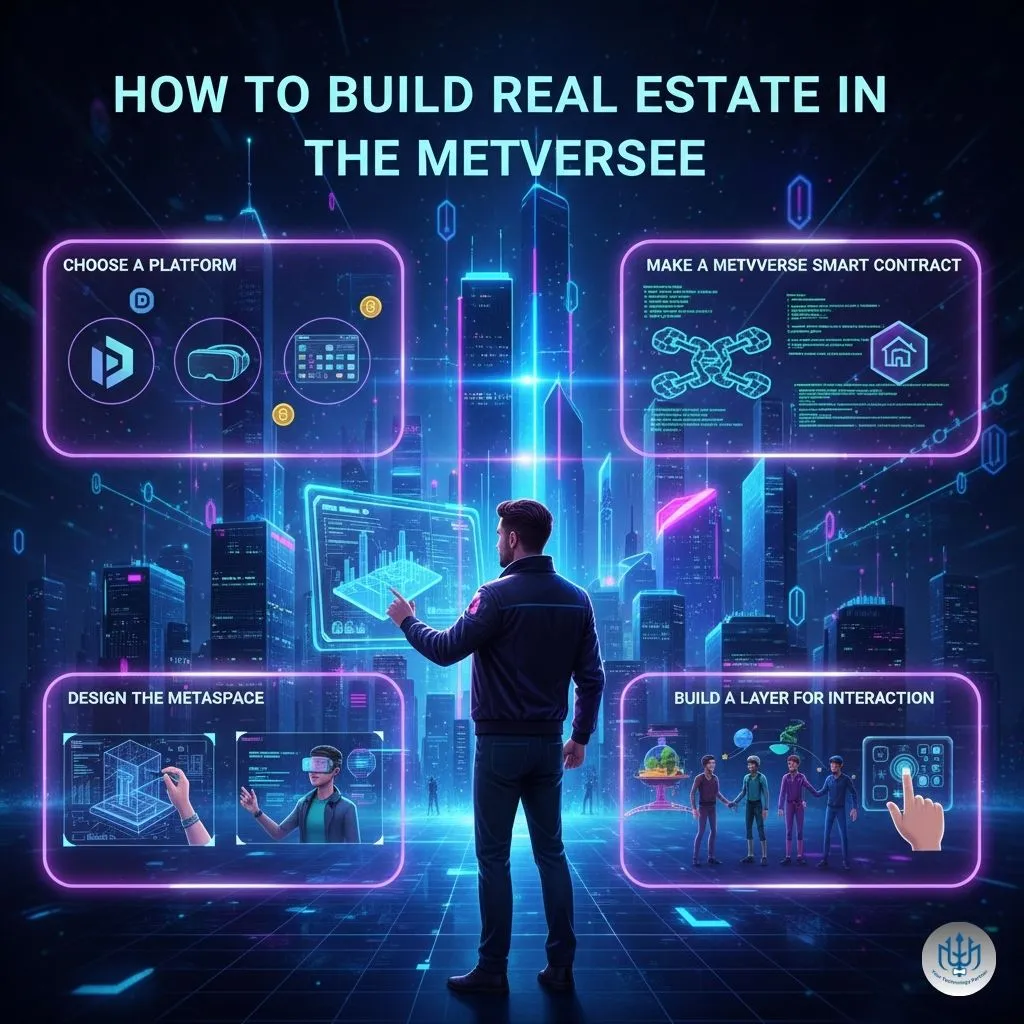
This process usually involves:
- Research and concept planning in the market.
- UI and 3D experience design
- Integrity of the blockchain and NFT.
- Configuration of the infrastructure at the back.
- AI feature implementation
- Testing and deployment
There is strong metaverse real estate development, which guarantees that it is scalable and long-term sustainable.
Real Estate App Development Cost
The real estate app development cost will be determined by various factors, including the complexity of the platform, integration of blockchain, 3D output, and AI. Simple platforms can be moderately invested in, whereas sophisticated immersive platforms can be very costly in terms of development.
Such factors as real estate app development cost include:
- Individual 3D environment development.
- Security infrastructure
- NFT and smart contracts integration.
- Recommendation engines based on AI.
Benefits of Investing in Virtual Real Estate Platforms
Early Market Advantage
Businesses entering early can secure prime digital locations before competition increases.
Global Accessibility
Investors worldwide can browse and invest without being constrained by geography.
New Revenue Streams
There are income opportunities for virtual events, advertising, leasing, and sales of digital assets.
Brand Innovation
The use of immersive virtual spaces to showcase products by companies makes them memorable
Through the integration of the knowledge of real estate property development and the strategies of the metaverse, businesses can open new avenues of expansion.
Why Businesses Need Expert Development Support Like Mayankal Technologies ?
To create immersive platforms, one should have knowledge in blockchain, AI, 3D modeling, and scalable infrastructure. An efficient real estate development company will also provide a smooth harmony of all the technical elements.
The aim of Mayankal Technologies is to develop smart and future-savvy digital ecosystems. From the real estate app development to the immersive metaverse real estate development, the objective is to provide scalable and secure solutions that can meet the changing market demands.
The Future of Virtual Real Estate
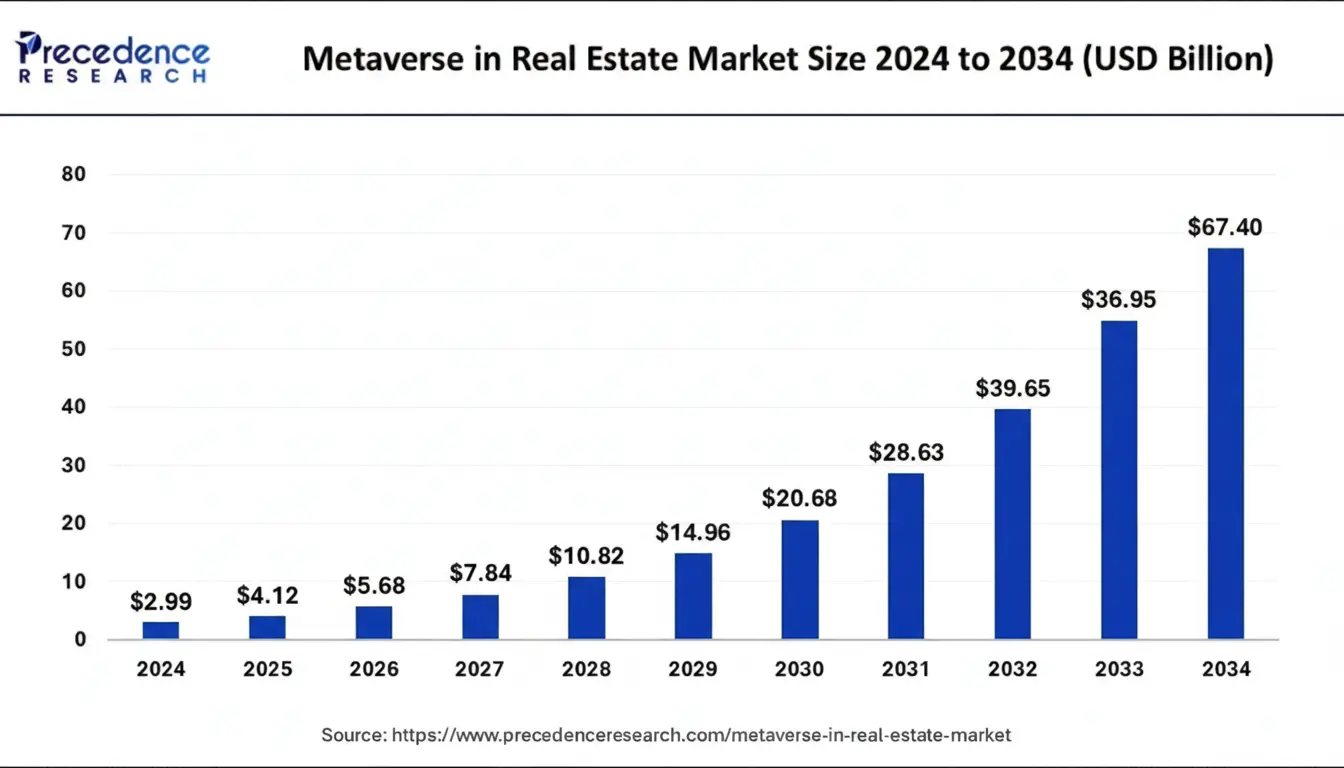
It is predicted that the metaverse will grow faster in the coming decade. The issue of digital ownership, decentralized marketplaces, and AI-wielding platforms will go on to transform the way property is valued and traded.
The virtual real estate metaverse concept is gradually transforming by becoming more of a speculative investment in real digital infrastructure. Companies that invest in powerful real estate application platforms nowadays have the ability to dominate tomorrow's digital economy.
With the development of immersive technologies, AI in real estate will support personalization and predictive analytics even more. This is AI combined with blockchain and will become the new generation of property platforms.
Conclusion
The virtual real estate and metaverse are not something of the future anymore. They are becoming constituent components of the digital economy. Immersive experiences coupled with secure infrastructure can enable businesses to build strong investment ecosystems.
All the steps, including planning metaverse real estate development strategies and the calculation of real estate app development cost, have to be thought through. Under the proper metaverse development service provider, such as Mayankal Technologies, firms can establish scalable systems, which will transform the manner in which individuals engage with property in the digital era.
The future of real estate is not only physical. It is experiential, smart and integrative.
FAQ'S
1. What is Metaverse real estate, and how does it differ from traditional real estate?
Metaverse real estate is a type of digital land or property that is found within virtual worlds. The properties may be purchased, sold, developed, or rented using blockchain-supported ownership systems like NFTs.
Metaverse properties, unlike conventional real estate, do not imply any physical land and buildings but are fully digital and accessed via a VR, AR, or web platform. Geographical boundaries are not set, and all transactions are usually done through the use of cryptocurrency rather than through conventional bank systems.
2. What is the best way to purchase virtual real-estate?
The process of purchasing virtual real estate typically has a few steps:
- Select a metaverse platform that has digital land or property.
- Install an electronic wallet that is compatible with the platform.
- Buy cryptocurrency that the site accepts.
- Search through virtual land listings.
- Finalize the deal through blockchain validation.
After being bought, the ownership is registered in the blockchain, providing the buyer with the digital representation of property rights.
3. What is the difference between metaverse real estate and physical real estate?
Metaverse real estate is located in the digital space, whereas physical real estate entails land and the construction of buildings.
Key differences include:
- Online realms rather than material goods.
- Traditional payment is replaced by cryptocurrency payments.
- There are no geographical restrictions.
- Construction of the development is based on 3D design and not on the construction materials.
- Value is based on the popularity of the platform and the number of users.
Whereas physical property is a factor of location and infrastructure, virtual property is based on platform usage and digital demand.
4. What are the most prominent issues in the metaverse property market and what could be done to solve them?
The following are some of the key challenges:
- Digital asset price volatility in the market.
- Regulatory uncertainty
- Cybersecurity risks
- Poor mainstream penetration.
The security measures can be enhanced, regulations made clear, blockchain clear, and users educated to overcome these hurdles. The collaboration with the skilled development teams also minimizes the risk of technical failures and provides the means of stable and reliable platforms.
Hi, I’m Akhil Kumar Srivastava, Founder & CEO of Mayankal. We’re a team of highly skilled developers helping startups and established companies transform powerful ideas into successful digital products. We build high-quality websites, mobile apps, AI-driven tools, and full-scale SaaS solutions.
Our Blog
Explore Our Latest Multi-Location
Marketing Insights
11 May 2026
How Much Does LMS Development Cost in India in 2026?

Akhil Kumar Srivastava

17 Apr 2026
Cost to Develop an Astrology App Like Astrotalk in 2026
Akhil Kumar Srivastava
04 Apr 2026
Top 10 No-Code Tools for Mobile App Development in 2026
Akhil Kumar Srivastava
23 Jan 2026
Detailed Guide on AI Agent Development Cost in 2026
Akhil Kumar Srivastava

09 Jan 2026
Gojek Business Model Complete Guide
Akhil Kumar Srivastava