
Mobile apps are not a privilege of expanding companies anymore. They now form part of the digital strategy in all industries. Global app downloads are expected to reach nearly 300 billion in 2025, showing the massive demand for mobile solutions.
At the same time, there are more than 5.4 billion smartphone users worldwide, and people spend an average of 4 to 5 hours daily using mobile apps. From shopping and banking to learning and entertainment, mobile applications now shape how consumers interact with businesses.
Due to this increasing demand, a lot of startups hasten into creation without adequate planning. Nevertheless, the development of an application without a proper roadmap can be disastrous. There are those startups that commence without first testing their idea, others that do not do competitor research, and those that overload it.
Underestimating development costs and skipping proper testing are also common mistakes. These issues frequently result in project delays, budget overruns, poor user experience, or even complete product failure.
This is where structured planning becomes essential. Preparing a detailed checklist before development helps businesses define their goals, validate their concept, and organize the development process more effectively. A definite checklist minimizes the occurrence of technical risks, scope creep, enhances inter-team collaboration, and facilitates easier product release. Hiring a mobile app developer in UK or using a mobile app development company in Poland, having a clear plan will leave you with high chances of coming up with a successful application.
This guide outlines everything businesses should prepare before starting development, based on industry best practices and practical project experience at Mayankal Technologies.
10-Step Pre-Development Checklist for Building a Successful Mobile App
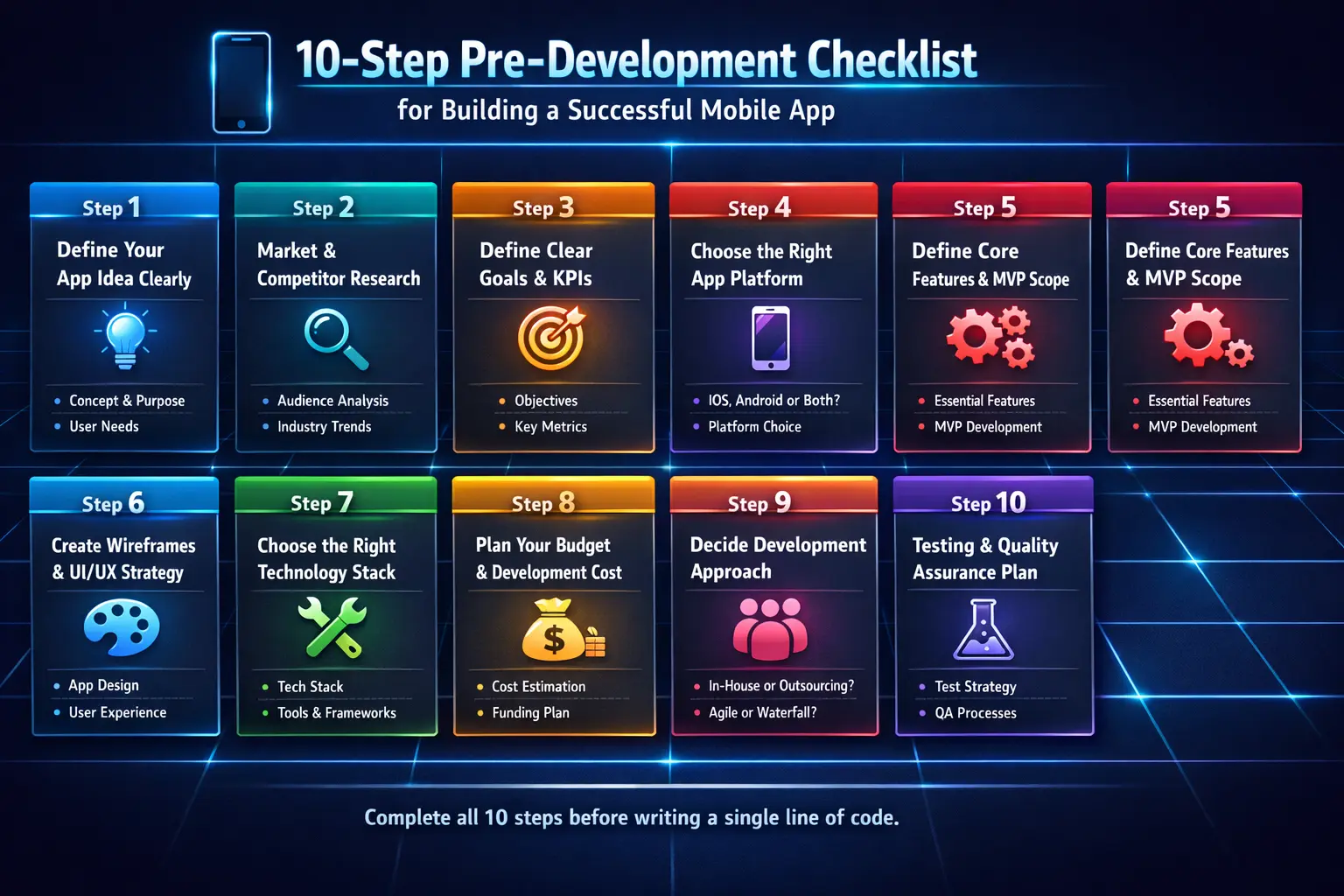
Let’s break down the most important steps you should complete before development begins.
1. Define Your App Idea Clearly
Start with clarity.
Ask yourself:
- What problem does the app solve?
- Who is the target audience?
- Why would users download it?
- What makes it different from competitors?
Write a simple value proposition statement. Keep it short and direct.
A well-defined idea makes communication easier with your development team and prevents confusion later.
2. Conduct Market and Competitor Research
Before investing money, validate demand.
Research:
- Existing apps in your niche
- Their features
- User reviews and complaints
- Pricing models
- Market gaps
App stores like Google Play and Apple App Store are gold mines for insights. Reviews reveal real user frustrations that you can solve.
Professional teams, including any experienced mobile app development company, perform detailed competitor benchmarking before writing a single line of code.
3. Define Clear Goals and KPIs
Success needs measurement.
Common app KPIs include:
- Number of downloads
- User retention rate
- Daily active users
- Conversion rate
- Revenue per user
Define what success means for your business.
For example:
- 50,000 downloads in 6 months
- 30% retention after 30 days
- 10% paid subscription conversion
Clear goals align your development and marketing efforts.
4. Choose the Right App Platform
You must decide early:
- Android
- iOS
- Both
- Web app
- Cross-platform
Each platform has different costs, timelines, and technical requirements. Platform selection directly impacts budget and timeline.
5. Define Core Features and MVP Scope
One of the biggest mistakes is building everything at once.
Instead, focus on MVP (Minimum Viable Product).
Ask:
- What are the must-have features?
- What can wait for version 2?
Example:
For a food delivery app, MVP features might include:
- User registration
- Restaurant listing
- Cart system
- Payment gateway
- Order tracking
Advanced analytics or loyalty programs can come later.
A focused MVP reduces development time and allows faster market testing.
6. Create Wireframes and UI/UX Strategy
User experience determines success.
Before development:
- Create low-fidelity wireframes
- Map user journey
- Define navigation structure
- Plan UI consistency
Wireframes help visualize app flow without writing code.
Professional design planning reduces future revisions and ensures smoother development.
User-friendly apps retain customers. Complicated apps lose them quickly.
7. Choose the Right Technology Stack
Technology decisions affect scalability and performance.
Consider:
- Native (Swift for iOS, Kotlin for Android)
- Cross-platform (Flutter, React Native)
- Backend framework
- Database
- Cloud hosting
Each stack has pros and cons.
An experienced mobile app development company evaluates:
- Project complexity
- Budget
- Timeline
- Scalability needs
Choosing the wrong technology can increase maintenance costs later.
8. Plan Your Budget and Development Cost
App development costs vary widely depending on:
- Features
- Platform
- Design complexity
- Development region
- Maintenance requirements
Break down your budget into:
- Design
- Development
- Testing
- Deployment
- Post-launch support
- Marketing
Discuss transparent pricing with your development partner. Reliable companies provide detailed proposals, not vague estimates.
9. Decide the Development Approach
Choosing the right methodology improves efficiency.
Two widely used approaches are:
- Agile
- Waterfall
The choice depends on project size and duration.
At Mayankal Technologies, we follow:
- Agile methodology for projects longer than 6 months
- Waterfall methodology for projects shorter than 6 months
We’ll explain the difference below.
In case of a long-term project that is over six months, we adopt an Agile approach to enable flexibility and frequent updates.
In brief projects that do not take more than six months, we adopt the waterfall methodology to have a predictable and organized delivery.
Agile vs Waterfall: Key Differences
Below is a simplified comparison:
Criteria | Agile Methodology | Waterfall Methodology |
| Project Duration | Best for long-term projects | Best for short-term projects |
| Flexibility | Highly flexible | Limited flexibility |
| Client Involvement | Continuous feedback | Feedback mostly at milestones |
| Scope Changes | Easy to implement | Difficult after planning phase |
| Risk Management | Lower risk due to iterative releases | Higher risk if early planning fails |
| Documentation | Lightweight | Detailed upfront documentation |
| Delivery Style | Incremental releases | Single final release |
Agile is effective in cases where the requirements can be changed.
Waterfall suits better where requirements are unchanging and clearly set out in the first place.
Making the incorrect decision may lead to time delays or overruns.
10. Create a Testing and Quality Assurance Plan
Testing is not optional.
Define:
- Functional testing
- Performance testing
- Security testing
- Device compatibility testing
- User acceptance testing
Apps that skip structured QA often face crashes, poor reviews, and low ratings.
A strong testing plan ensures smooth performance across devices and platforms.
Our Step-by-Step Mobile App Development Process
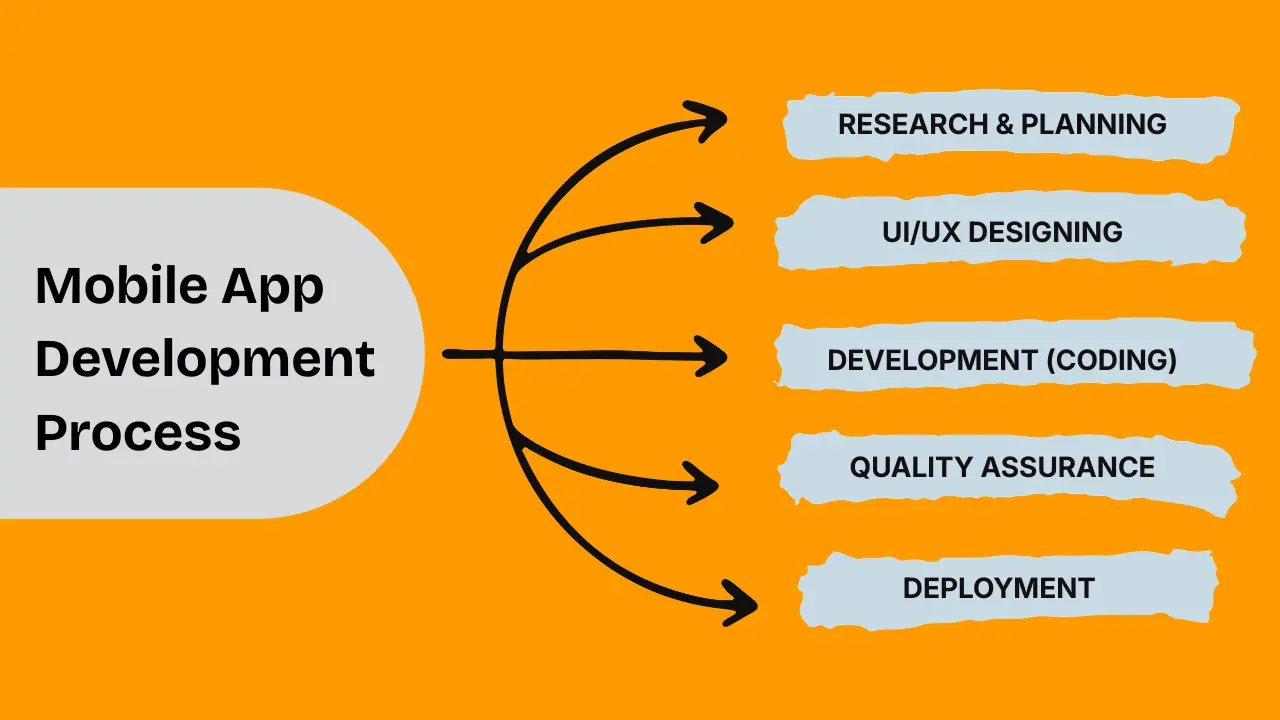
In Mayankal Technologies, the strategy comes first, and then the code comes later. Each phase is well designed to minimize risk, enhance clarity, and scalability in the long term.
1. Requirement Analysis and Consultation
We start by knowing business goals, target market, technical requirements, and growth strategies. Extensive consultations assist in outlining the project scope, timelines, and quantifiable deliverables prior to proceeding.
2. Market Validation
We test your idea prior to development by competitor research, understanding of your users, and market trends to make sure that there is actual demand and to have a chance to differentiate.
3. Wireframing and UI/UX Design
We develop wireframes and user journeys, which are visualizations of the layout and flow of the apps. The emphasis is on the intuitive navigation, user interaction, and the look and feel.
4. Technology Stack Selection
The technologies our team will choose are most appropriate in terms of scalability, security, performance, and the complexity of the project to make your application future-proof and cost-efficient.
5. Development Sprint Planning
To achieve organized implementation, we break down the project into small, manageable sprints or milestones. This will guarantee transparency in deliverables, transparency in the timeline, and a smooth tracking of progress.
6. Iterative Development
The app is created in phases, and it enables constant advancement, addition of features, and feedback to keep it on track with the business objectives.
7. Testing and QA
Extensive testing is done to make sure that the app functions effectively on different devices and platforms. Our pre-launch attention is on functionality, performance, security, and user experience.
8. Deployment Support
We take care of the entire submission of the apps in the app store and make sure they adhere to platform rules, and aid in the seamless implementation process without technical hiccups.
9. Post-Launch Maintenance
We also perform continuous monitoring, updates, optimization of performance, and add value features after launch to ensure that the app remains secure, stable, and competitive in the market.
Final Thoughts
It is risky to start the development of mobile apps unprepared. A checklist is a guideline that keeps your investment safe and increases your chances of success.
Define your idea clearly. Validate the market. Choose the right platform. Limit features to MVP. Plan budget wisely. Choose the appropriate methodology. Test thoroughly.
Most importantly, collaborate with a reputable mobile app development company, which will have the knowledge of your business objectives.
In Mayankal Technologies, strategy, planning, and clarity are the starting points of projects. The basis guarantees successful implementation, on-time performance, and scalability.
An app developed properly does not just work. It creates growth, enhances user interaction, and creates sustainable brand value.
Hi, I’m Akhil Kumar Srivastava, Founder & CEO of Mayankal. We’re a team of highly skilled developers helping startups and established companies transform powerful ideas into successful digital products. We build high-quality websites, mobile apps, AI-driven tools, and full-scale SaaS solutions.
Our Blog
Explore Our Latest Multi-Location
Marketing Insights

11 May 2026
How Much Does LMS Development Cost in India in 2026?

Akhil Kumar Srivastava

17 Apr 2026
Cost to Develop an Astrology App Like Astrotalk in 2026
Akhil Kumar Srivastava
04 Apr 2026
Top 10 No-Code Tools for Mobile App Development in 2026
Akhil Kumar Srivastava

09 Jan 2026
Gojek Business Model Complete Guide
Akhil Kumar Srivastava
23 Jan 2026
Detailed Guide on AI Agent Development Cost in 2026
Akhil Kumar Srivastava