
The demand for digital home services is rising fast. From cleaning and plumbing to beauty and repair services, users now expect everything to be available on their phones. This shift has created a strong opportunity for businesses to invest in app-based service platforms.
If you're planning to enter this space, one of the first questions that comes up is cost. Building a feature-rich and scalable app requires careful planning, the right tech stack, and a clear budget.
This guide explains development costs, key features, business models, and steps to launch in 2026.
Why Home Services Apps Are Growing Rapidly ?
The on-demand economy continues to expand. Customers prefer convenience, quick bookings, and reliable service providers. Apps solve all these problems in one place.
Several factors are driving this growth:
- Busy lifestyles are increasing demand for on-demand services, with studies showing that over 60% of urban consumers now prefer online service booking for faster and more convenient scheduling.
- Smartphone adoption continues to grow rapidly, with global smartphone users expected to exceed 7 billion, creating a larger audience for mobile-based home service platforms.
- Digital payment usage has surged significantly in recent years, with cashless transactions becoming the preferred payment method for millions of users worldwide.
- Trust-based features such as ratings, reviews, verified professionals, and live tracking improve customer confidence up to 80 percent, and research shows that platforms with verified providers see higher repeat bookings.
- The global on-demand home services market is projected to grow steadily in the coming years, driven by increasing digital adoption and consumer preference for app-based convenience.
Businesses that invest early in this segment can capture a strong market share.
How to Start Home Cleaning Business in 2026
Launching a home cleaning services along with an app can be a smart move. It creates both supply and demand within your platform.
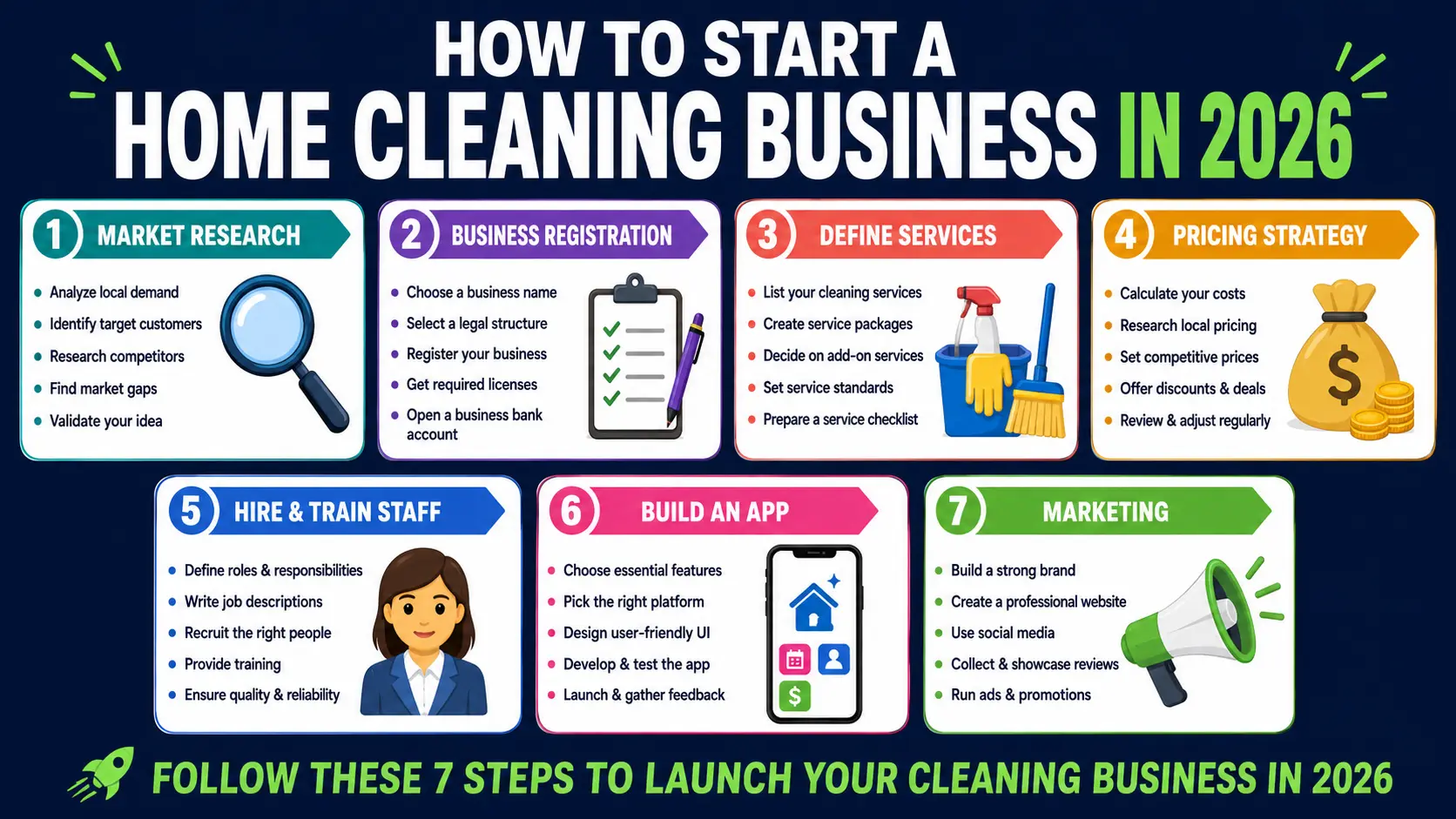
Step 1: Market Research
Understand your target audience and local demand. Identify gaps in services.
Step 2: Business Registration
Register your business legally and obtain necessary licenses.
Step 3: Define Services
Offer clear service packages such as:
- Deep cleaning
- Kitchen cleaning
- Sofa cleaning
- Bathroom cleaning
Step 4: Pricing Strategy
Keep pricing competitive but profitable.
Step 5: Hire and Train Staff
Quality service depends on skilled workers. Training ensures consistency.
Step 6: Build an App
A mobile application helps manage bookings and scale operations with ease.
Step 7: Marketing
Use digital marketing strategies:
- Social media ads
- Local SEO
- Referral programs
An Overview of Home Services Applications
A home services app is a platform that connects customers with service providers. It acts as a bridge between demand and supply.
Common services include:
- Home cleaning
- Plumbing
- Electrical work
- Beauty services
- Appliance repair
The app usually includes three panels:
- User app
- Service provider app
- Admin dashboard
Each plays a crucial role in managing bookings, payments, and service delivery.
Key Factors That Affect Development Cost
The cost of on demand home services mobile app development is not fixed. It depends on several variables. Understanding these helps in better planning.
1. App Complexity
Apps with basic features usually cost less. Advanced apps with AI tips, real-time tracking, and automation cost more.
2. Platform Choice
- Single platform (Android or iOS): lower cost
- Cross-platform: moderate cost
- Native apps for both: higher cost
3. Design Quality
A simple, user-friendly UI/UX is crucial. High-end design comes with increased time and cost.
4. Features and Integrations
More features mean more development hours. Integrations like payment gateways, maps, and chat systems also add to the cost.
5. Development Team Location
Hiring a home service app development company in India often costs less than in Western markets. It can still maintain quality.
6. Maintenance and Updates
Ongoing updates, bug fixes, and feature improvements need a separate budget.
Estimated Development Cost in 2026
Here’s a clear cost breakdown based on app complexity.
| App Type | Features Level | Estimated Cost |
| Basic App | Booking, login, simple UI | $8,000 – $15,000 |
| Mid-Level App | Payments, tracking, notifications | $15,000 – $35,000 |
| Advanced App | AI, analytics, multi-services | $35,000 – $80,000+ |
These are general estimates. The final cost depends on your needs.
Must-Have Features for a Home Services App
A successful app depends on features that are simple, reliable, and easy to use. Build each panel to do its job well and keep the experience smooth for users, providers, and admins.
User Panel Features
These features focus on convenience and a seamless booking experience.
- Easy registration and login: Enable quick registration using email, phone, or social accounts.
- Service search and filters: Users can find services based on category, location, price, or ratings.
- Booking scheduling: Flexible time slots for booking services as per user preference.
- Secure payments: Multiple payment options with safe and smooth transactions.
- Ratings and reviews: Helps users choose trusted service providers.
- Real-time tracking: Track service provider location and job progress in real time.
Service Provider Panel
This panel helps professionals manage their work efficiently.
- Profile management: Update personal details, services offered, and pricing.
- Job notifications: Instant push notifications for new bookings and updates.
- Earnings tracking: Clear view of income, completed jobs, and service booking.
- Availability status: Set working hours and availability to avoid conflicts.
- Navigation support: Built-in maps to reach customer locations easily.
Admin Panel
The admin panel ensures smooth platform management and control.
- User and provider management: Manage registrations, approvals, and activity.
- Order tracking: Monitor all bookings and service status in real time.
- Commission management: Set and track platform earnings from each transaction.
- Analytics dashboard: Insights into user behavior, revenue, and performance.
- Customer support tools: Handle queries, complaints, and feedback efficiently.
A balanced mix of these features builds a strong base for a scalable, user-friendly home services app.
Advanced Features That Increase Value
In 2026, basic functionality is no longer enough for apps to stand out. Adding advanced features improves the user experience. It also helps your platform stay competitive and scalable over time.
- AI-based service recommendations: Suggest services based on user behavior, past bookings, and preferences. This helps create a more personalized user experience.
- Dynamic pricing models: Adjust service pricing based on demand, location, or peak hours to maximize revenue and efficiency.
- Subscription plans: Offer regular service packages for users. This helps ensure steady bookings and predictable income.
- Voice search integration: Allow users to search and book services with voice commands. This makes interactions faster.
- Chatbots for instant support: Provide fast replies to common questions. This boosts customer satisfaction without raising support costs.
- Loyalty and referral programs: Reward users for repeat bookings and referrals. This helps boost retention and organic growth.
These features make the platform more engaging, encourage repeat use, and help build long-term customer relationships.
Development Timeline
The timeline depends on the app’s complexity.
| Stage | Duration |
| Planning | 1–2 weeks |
| Design | 2–4 weeks |
| Development | 8–16 weeks |
| Testing | 2–3 weeks |
| Launch | 1 week |
On average, building a complete application takes 3 to 6 months.
How to Reduce Development Cost
Smart planning plays a key role in keeping your development cost under control. Instead of building everything at once, a step-by-step approach helps reduce risk and avoid unnecessary expenses.
- Start by building a Minimum Viable Product (MVP): An MVP is the first basic version of your app that includes only the core functionality required to solve the main problem for users. Instead of investing heavily in a full-featured product from the beginning, businesses can launch a simpler version and test how users respond.
This approach helps validate the idea before spending a large budget on advanced development. It also allows businesses to gather real user feedback, understand market demand, and identify which features users actually value. By fixing issues early and improving the app gradually, companies avoid wasting money on features that may never be used. - Focus on essential features first: One of the most common reasons development costs increase is adding too many features during the initial phase. While advanced features may sound attractive, not every feature is necessary for the first release.
Businesses should focus on features that directly improve user experience and support the app’s main purpose. Core functionalities should always come first, while secondary or experimental features can be added later based on customer feedback and business growth. - Use cross-platform development: Cross-platform development frameworks like Flutter and React Native allow developers to create apps for both Android and iOS using a single codebase.
Instead of building two separate native apps, developers can reuse most of the same code across platforms. This significantly reduces development time, testing effort, and long-term maintenance costs. - Avoid unnecessary integrations: Third-party integrations such as payment gateways, analytics tools, chat systems, location services, and APIs can improve app functionality, but adding too many integrations can quickly increase development costs.
Each integration requires additional setup, testing, security checks, and ongoing maintenance. Some third-party services also charge monthly or usage-based fees, which increases long-term operational expenses. - Choose an experienced development partner: Hiring an experienced app development company may seem expensive initially, but it often saves money in the long run. Skilled developers can create a clear project roadmap, recommend cost-effective solutions, and avoid technical mistakes that could lead to delays or rework.
An experienced team also understands how to optimize app architecture, improve performance, and select the right technologies from the beginning. This reduces the chances of unexpected technical issues later in the project. - Plan for future flexibility early: Many businesses focus only on launching the app quickly and ignore long-term scalability. However, rebuilding or restructuring an app later can become extremely expensive.
Planning for flexibility from the beginning helps developers create a scalable backend architecture that can support future growth, additional users, and new features without major redevelopment.
Working with custom home services app developers helps speed up the process and avoid common mistakes. These mistakes can raise costs.
Why Choose Mayankal Technologies
Choosing the right development partner is important.
Mayankal Technologies builds scalable, user-friendly home service apps that fit your business needs.
Key advantages:
- Experienced development team
- Cost-effective solutions
- Focus on user experience
- Scalable architecture
- Ongoing support and maintenance
.webp)
The company understands market trends and builds apps that are ready for future growth.
Challenges in App Development
Every project comes with challenges. Being prepared helps avoid delays.
- Managing real-time data
- Ensuring app security
- Handling multiple service categories
- Maintaining service quality
- Scaling infrastructure
Working with skilled teams can greatly reduce these risks.
Future Trends in 2026
The home services industry will keep evolving as new technology changes how users book and receive services. Businesses that adapt early will gain a clear edge in this competitive market.
- AI and Automation
Smart algorithms will manage tasks, pricing, and customer support. Automated workflows will cut manual work and speed up service.
- Hyperlocal Services
Apps will focus more on nearby service providers. This will ensure faster response times. Improving availability for urgent needs is another benefit.
- Eco-Friendly Services
A clear shift toward sustainable practices will occur, with users choosing eco-friendly cleaners and energy-saving solutions.
- Voice and Smart Home Integration
Booking services through voice assistants and smart devices will become more common, making the process quicker and hands-free.
- Data-Driven Insights
Advanced analytics helps businesses understand customer behavior. It also helps optimize pricing and improve service quality.
Cost Breakdown by Development Stage
Here’s a more detailed cost split:
| Stage | Estimated Cost |
| UI/UX Design | $2,000 – $8,000 |
| Frontend Development | $5,000 – $20,000 |
| Backend Development | $7,000 – $25,000 |
| Testing | $2,000 – $6,000 |
| Maintenance | $1,000 – $5,000/year |
Mistakes to Avoid
- Skipping market research can lead you to build an app that users do not need or use.
- Adding too many app features early raises costs and slows development.
- Ignoring user experience can lower engagement, even if the app works well.
- Choosing cheap but immature developers often results in poor quality and rework.
- Not planning for flexibility can create issues when user demand starts growing.
- Lack of clear project requirements can cause confusion and delays during development.
- Ignoring testing and quality checks may lead to bugs and poor performance after launch.
- If you do not plan updates after launch, you may limit long-term growth and user retention.
Final Thoughts
In 2026, building home services applications is a strong business opportunity.
Success depends on smart planning and strong execution. Costs can vary widely, but a well-structured approach keep everything under control.
Start with a clear idea, focus on essential features, and gradually scale your platform. Combining a solid business model with the right technology can create a long-term revenue stream.
Choosing the right mobile app development company is key to building a reliable, scalable app. Working with experts like Mayankal Technologies helps you build it faster. It also keeps your app ready to grow in a competitive market.
Hi, I’m Akhil Kumar Srivastava, Founder & CEO of Mayankal. We’re a team of highly skilled developers helping startups and established companies transform powerful ideas into successful digital products. We build high-quality websites, mobile apps, AI-driven tools, and full-scale SaaS solutions.
Our Blog
Explore Our Latest Multi-Location
Marketing Insights

11 May 2026
How Much Does LMS Development Cost in India in 2026?

Akhil Kumar Srivastava

17 Apr 2026
Cost to Develop an Astrology App Like Astrotalk in 2026
Akhil Kumar Srivastava
04 Apr 2026
Top 10 No-Code Tools for Mobile App Development in 2026
Akhil Kumar Srivastava
23 Jan 2026
Detailed Guide on AI Agent Development Cost in 2026
Akhil Kumar Srivastava

09 Jan 2026
Gojek Business Model Complete Guide
Akhil Kumar Srivastava